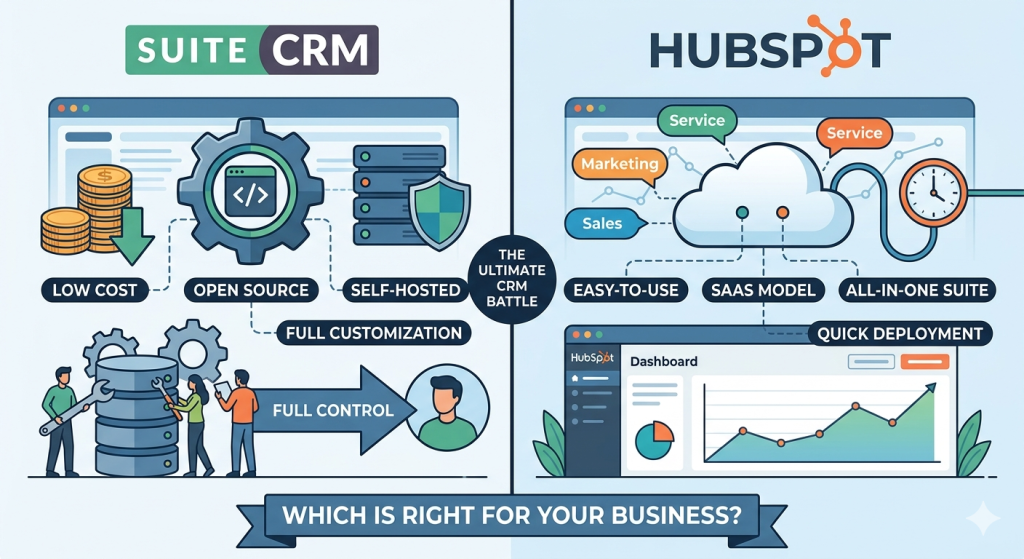
Choosing the right Customer Relationship Management (CRM) system is a critical decision that directly impacts your sales efficiency and customer satisfaction. While the market is flooded with options, SuiteCRM and HubSpot are the two industry titans—each representing a fundamentally different philosophy.
This guide breaks down the core differences to help you decide which platform best fits your business goals.
1. Deployment Model & Cost Structure
- HubSpot: Operates on a SaaS (Software as a Service) model. It offers a low barrier to entry with a “freemium” approach. However, as your business scales, costs can escalate rapidly due to recurring subscription fees based on the number of users and total contact count.
- SuiteCRM: Built on an open-source architecture, SuiteCRM offers a self-hosted, flexible deployment model. You retain full control over your infrastructure, meaning you are not beholden to per-user monthly licensing fees. Your investment is shifted toward initial configuration and server management, offering far greater cost predictability as your organization grows.
2. Customization & Data Sovereignty
- HubSpot: Offers a sleek, intuitive interface that is ready out of the box. While easy to use, you are essentially “renting” the software and must operate within the constraints of their proprietary ecosystem.
- SuiteCRM: Provides unparalleled flexibility. Businesses can perform deep code-level customizations, modify database schemas, and tailor workflows to match unique internal processes. More importantly, you maintain 100% data sovereignty—a vital requirement for industries with strict compliance or data privacy mandates.
3. Ecosystem & Modern Tech Integration
- HubSpot: Features a powerful, all-in-one suite covering Marketing, Sales, and Service. However, accessing advanced automation and reporting usually requires upgrading to their premium enterprise tiers.
- SuiteCRM: Designed for extensibility. It easily integrates with modern web stacks, allowing developers to leverage tools like Next.js, PostgreSQL, and Docker for high-performance deployments.Modern innovation is making open-source CRM more competitive than ever. By integrating advanced artificial intelligence, companies can now transform their CRM into a powerhouse. Check out the innovative capabilities at MTS CRM to see how AI-driven voice intelligence and automated lead scoring are taking CRM efficiency to the next level.
Quick Comparison Table
| Feature | HubSpot | SuiteCRM |
| Model | SaaS (Cloud) | Open Source (Self-hosted/Cloud) |
| Pricing | Recurring (Scales with usage) | Cost-effective, no per-user limits |
| Data Ownership | Hosted by vendor | 100% Owned by you |
| Customization | Standardized/Limited | Fully customizable/Open source |
| AI Integration | Proprietary/Tiered | Flexible via API & custom plugins |
The Verdict
Choosing between the two comes down to your long-term business strategy:
- Choose HubSpot if you need a rapid, “plug-and-play” solution and have the budget to support rising subscription costs as you scale.
- Choose SuiteCRM if you prioritize cost-efficiency, absolute control over your data, and the ability to customize your system to integrate with modern tech stacks.
For businesses looking to bridge the gap between traditional CRM functionality and cutting-edge tech, explore how to optimize your operations at MTS CRM.